ST-03 · SPEC
What White-Label GoHighLevel Support Really Costs
White-label GoHighLevel support runs $197 to $997 a month and renews forever. The three-year arithmetic, what the plan rents versus what an owned build replaces.
Three years ago an agency owner we know signed up for a white-label support plan at $549 a month. It was the right call at the time. She had six clients, no support staff, and a plan that answered tickets under her brand for less than the cost of a part-time hire. Last month she added it up. The plan had taken $19,963 across those three years, and in that time she had installed the snapshots it came with exactly twice. The support she uses. The build library she rented and barely touched. She was paying a monthly fee to keep owning something she had already stopped needing.
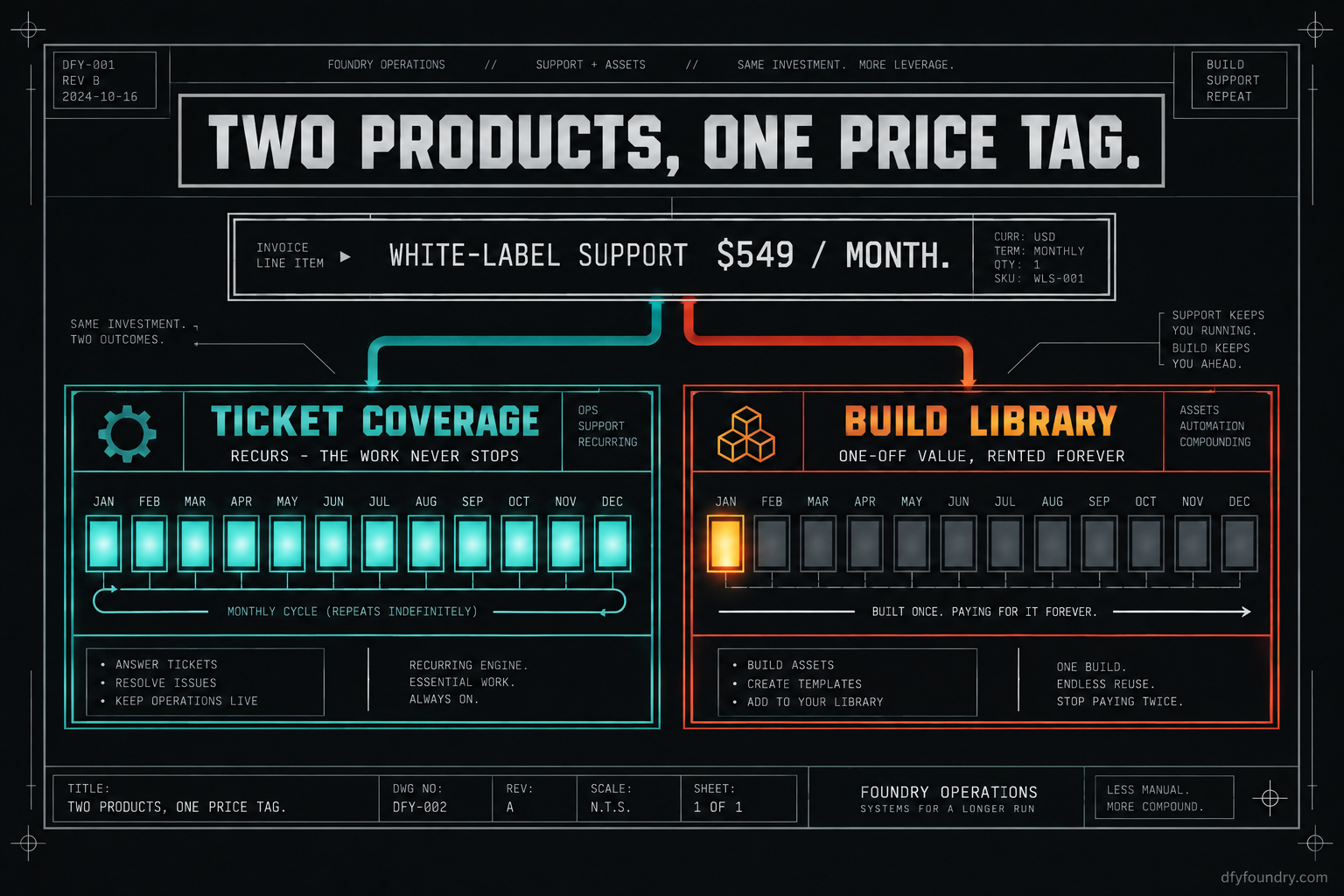
That is the shape of the problem. White-label support is sold as one line item, but it is two things bolted together: human coverage that recurs because the work recurs, and a build library that recurs even though the build is a one-time job. This is what the plans cost in 2026, what each half is actually worth, and where the monthly model quietly bills you for a part you should own outright.
What the monthly plan is actually renting
Open any white-label support provider’s page and the pitch is coverage. Your clients get live chat, phone and email support under your logo, answered by someone who is not you, often around the clock. That part is real and it is worth money. An agency running client sub-accounts fields the same twenty questions forever, and paying a team to field them is a fair trade.
But the coverage is bundled with a second thing, and the second thing is where the arithmetic goes sideways.
The three things sold as one
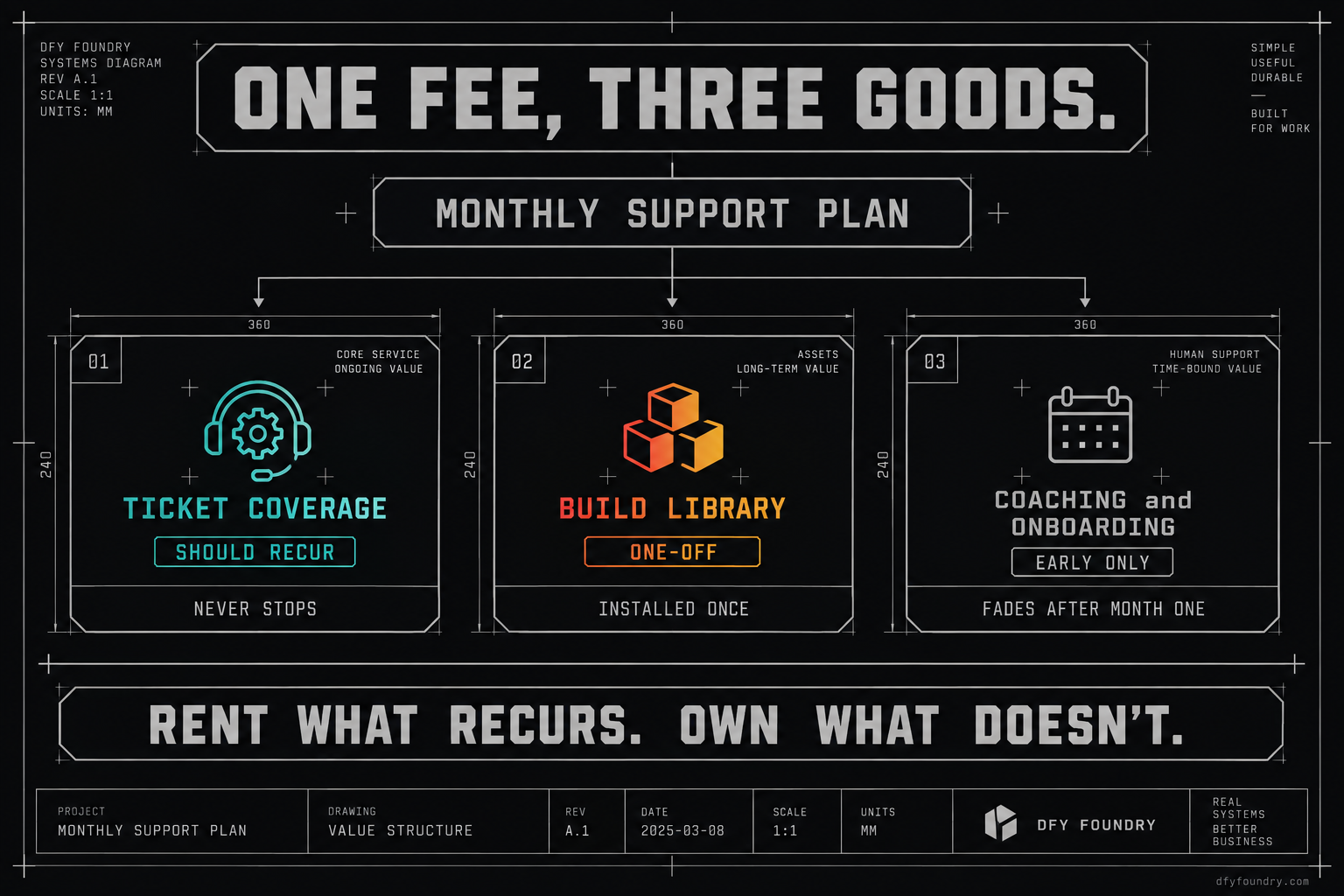
Almost every plan folds three separate goods into a single monthly fee.
The first is ticket coverage. Real people answering your clients’ questions under your brand. This is labour, it recurs because the questions never stop, and renting it monthly is the correct structure.
The second is a shared snapshot and template library. A stack of pre-built client accounts, funnels and automation you can install into a sub-account. HL Pro Tools bundles SaaS snapshots, funnel templates and theme builders. Growthable’s higher tiers add what they call bonus SaaS snapshots. This is not labour. It is a finished good. Once you have installed the one you need, the library has done its job, and you keep paying for it every month anyway.
The third is onboarding and coaching: weekly calls, done-for-you client onboarding sessions, a knowledge base. Useful early, largely ignored once your team knows the platform.
The reason this matters is that the three goods have completely different natural billing. Coverage should recur. A build library should not. When they arrive on the same invoice, the recurring price of the coverage hides the fact that you are also renting the builds forever.
How the billing reads on the page
The numbers are public, at least for two of the big providers, and they are worth reading side by side rather than off memory.
HL Pro Tools publishes a tiered rate card: CORE at $197 a month, VIP at $397 a month for branded chat, phone and video support up to ten clients, and Elite at $997 a month once you pass the ten-client cap, with onboarding calls included each month. A Platinum tier is quote-only. Those figures were checked on 17 September 2026 and confirmed across current pricing pages rather than fetched from the vendor directly.
Growthable prices its white-label human support at $549 a month plus a $199 one-time setup on the Starter tier, $649 a month plus $99 setup on Ultimate, and $899 a month plus $99 setup on Pro. Its Agency Enterprise tier is $2,000 a month and folds in a HighLevel-certified assistant at twenty hours a week. Growthable also runs a separate Agency AI plan at $197 a month with a seven-day trial. Same check date, same snippet-confirmed basis.
Extendly prices annually rather than monthly: a Plus tier around $2,990 a year and an Ultimate around $5,990 a year that includes twenty-five client onboardings, with extra onboardings at $99 each. Promotional pricing has put the Plus tier near $1,490 for a first year. Extendly is explicit that its support stops short of done-for-you work like customising funnels or building workflows, which is the honest version of what most of these plans actually cover.
Set against those, the platform itself is a separate bill nobody in this category includes: GoHighLevel is $97 a month on Starter, $297 on Unlimited, or $497 on Agency Pro, with a roughly seventeen percent discount for paying annually and a fourteen-day trial on every tier. Every route pays that, so it drops out of the comparison below.
Where the monthly model quietly costs you
The plans are not scams. They are priced fairly for what they mostly are, which is coverage. The trouble starts where the coverage model is stretched over the parts of the offer that are not coverage. Here is where a build comes out of that mould wrong.
You pay every month for a build you install once
This is the big one. The snapshot library inside a support plan is a finished good. You browse it, you find the account that fits your client’s trade, you install it, and from that day the library has delivered its value. The next month’s fee buys you nothing new on that front. The month after, the same.
What you see is a reasonable monthly line item. What is actually happening is that the one-time value of a build is being amortised across an open-ended subscription, so the longer you stay, the worse the per-build price gets. Install two builds across three years on a $549 plan and the builds cost you roughly ten thousand dollars each in fees, before you count the hours you spent finishing generic library work into something a client would accept.
The fix is to separate the two purchases. Keep a coverage plan if and only if you need humans answering tickets. Buy the builds you actually install as one-off owned assets. A single HVAC company snapshot or med spa clinic snapshot is paid once, licensed for unlimited sub-accounts under your agency, and never renews.
The bundled snapshots are shared with everyone on the plan
A support plan’s library is the same library every subscriber installs. That is the whole economic model of a bundled snapshot: build it once, license it to thousands. It also means the funnels, the copy and the automation logic your client ends up with are identical to those of every other agency’s client on the same plan.
What you see is a functional account. What is wrong is that it is a stock account. The buyer’s own offer, their pricing, their voice, are not in it until you put them there by hand, and the parts that make a build feel bespoke, the custom values and custom fields that expose every client-specific detail so the account is data entry rather than engineering, are built for the generic case, not for the client in front of you.
The fix is a build written for the trade and then rebranded to the client, which is what the free installation window on an owned build is for. Ours covers installing the snapshot, rebranding the site, A2P and 10DLC registration and setup, email domain setup in GoHighLevel, and a few extra automations where the build needs them: fifteen hours of dedicated installation support, to be used within eight days of purchase.
The setup fee and the per-onboarding fee, stacked
The monthly number is the number you remember. It is rarely the number you pay. Growthable adds a $199 setup on Starter and $99 on the tiers above. Extendly meters client onboardings, charging $99 each once you pass the included count. HL Pro Tools historically sold branded onboarding calls for your clients as a separate $97 item on top of membership.
What you see is a clean headline price. What is wrong is that the real first-year cost is the headline times twelve plus a setup fee plus however many onboardings you run at a per-head rate. None of it is hidden exactly, but none of it is on the button you click either, and it compounds.
The fix is to price the whole first year before you sign, with every per-unit fee multiplied out at your real client volume, and to hold that total next to what the same outcome costs as one-off work. A build sold at a published, final price does not do this to you. The price on a snapshot is the price, delivery is within twenty-four business hours of purchase confirmation, and installation is free with the build.
Cancel, and the branded support leaves with the plan
The coverage you are renting is wired into your clients’ experience. When they open the chat widget or email support, a team you pay for answers under your name. The day you stop paying, that team stops answering.
What you see is a subscription you can cancel any time. What is wrong is that cancelling is not neutral. Your clients notice the support quality change immediately, because the humans behind it are gone, and anything the plan onboarded is now yours to cover with staff you may not have. The switching cost is real and it grows with every client you route through the plan, which is exactly the lock-in the monthly model is built to create.
The fix is to know, before you sign, what you will do the month you leave. If the answer is “hire the coverage in-house” or “move it to a build bench that runs the accounts for me,” you have a plan. If the answer is “I cannot leave,” you have a dependency, not a service.
The plan will not build the thing you actually needed
The line Extendly draws in writing is the line most of these plans draw in practice: support answers questions, it does not do the build. So the agency signs up expecting the plan to shoulder the client account, discovers the plan will coach them through building it but will not build it, and ends up doing the build anyway, on top of the monthly fee.
What you see is an “agency in a box.” What is wrong is that the box contains help and templates, not a finished, tested account handed over ready for a client to log into. Those are different products, and paying for the first while needing the second is the most common way agencies overspend in this category.
The fix is to buy the finished build as a build and the coverage as coverage, from whoever does each one properly, rather than one monthly fee that half-does both.
The three-year arithmetic
A monthly fee is small. Thirty-six of them are not. Here is every published plan carried out to three years, so the running total sits next to the sticker price. The figures exclude the GoHighLevel subscription, because every agency pays that no matter which route it takes.
| Plan | Monthly | Setup | First-year cost | Three-year total |
|---|---|---|---|---|
| HL Pro Tools CORE | $197 | none | $2,364 | $7,092 |
| HL Pro Tools VIP | $397 | none | $4,764 | $14,292 |
| HL Pro Tools Elite | $997 | none | $11,964 | $35,892 |
| Growthable Starter | $549 | $199 | $6,787 | $19,963 |
| Growthable Ultimate | $649 | $99 | $7,887 | $23,463 |
| Growthable Pro | $899 | $99 | $10,887 | $32,463 |
| Growthable Agency Enterprise | $2,000 | none | $24,000 | $72,000 |
| Extendly Plus (annual) | n/a | n/a | ~$2,990 | ~$8,970 |
| Extendly Ultimate (annual) | n/a | n/a | ~$5,990 | ~$17,970 |
Now the assumptions, so you can substitute your own. The three-year totals are the monthly fee times thirty-six, plus a one-time setup where the provider charges one. They assume you stay on the same tier the whole time, which understates the real number for any agency that grows into a higher tier. They exclude per-onboarding fees, which add up fast on Extendly’s model at your client volume. They exclude the GoHighLevel bill, which at Unlimited is $2,970 a year, or $8,910 over the three years, common to every route.
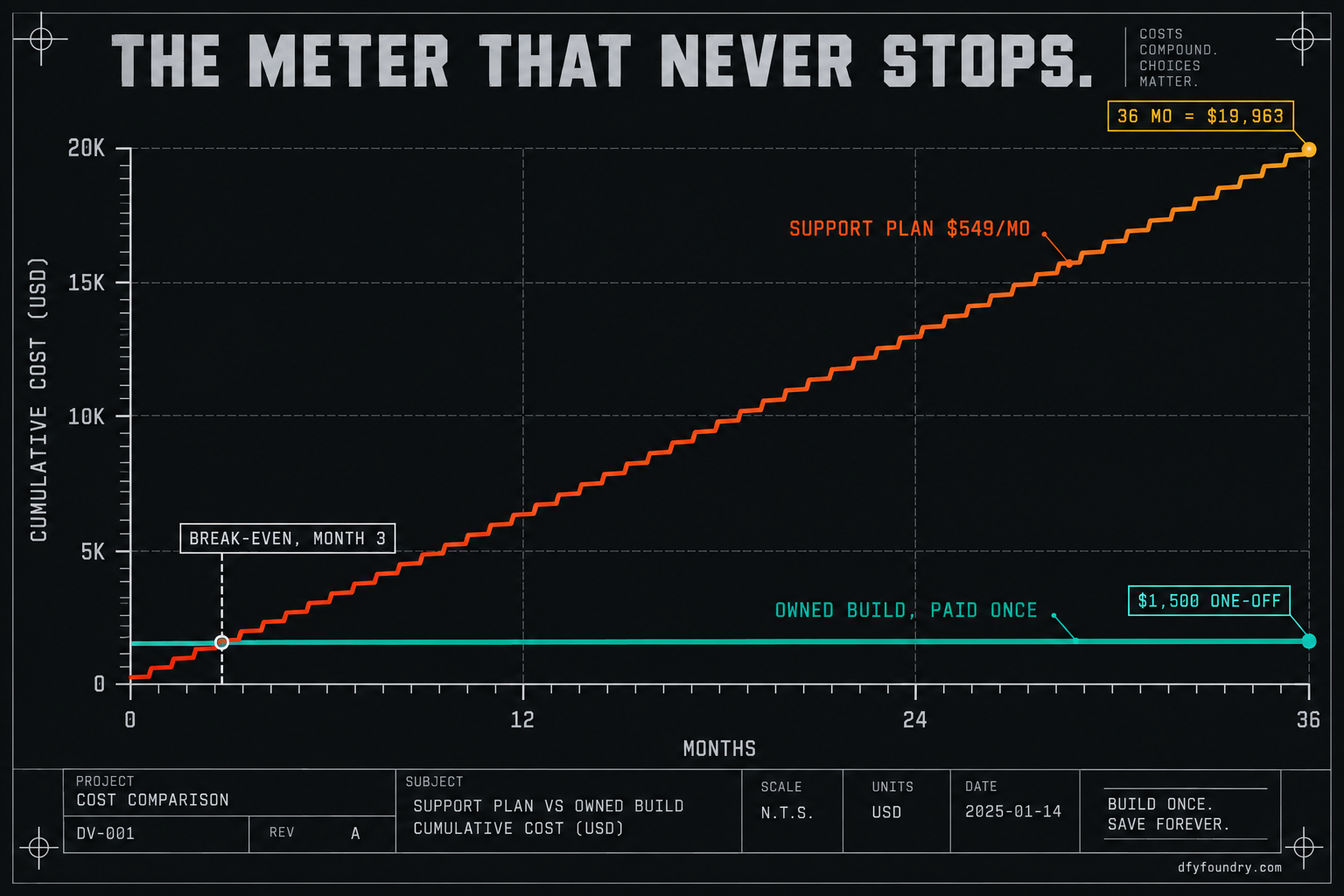
Against those recurring totals, put the one-off cost of the thing most agencies are actually renting. An owned build in our catalogue runs $920 to $2,280, paid once, licensed for unlimited sub-accounts, with twelve months of updates. Full white-label agency setup, the whole account plus a build, is from $3,900, paid once. The complete sheet is on the pricing page.
Say you need three builds across three years and no human ticket coverage, because you answer support yourself. On the cheapest published support plan, HL Pro Tools CORE, that is $7,092 in fees for a library you dip into three times. Three owned builds at the middle of our band land near $4,500, paid once, and the meter never starts. The gap widens every month you keep the plan running past the last install.
Now say you genuinely need coverage: a team answering client tickets around the clock so you can sleep. That is labour, it recurs, and a support plan is a reasonable way to buy it. The honest read is that the plan is worth its price for the coverage and worth almost nothing for the bundled builds, so the right move is to keep the plan for what recurs and buy the builds as one-off owned assets rather than renting them inside it.
The objections, including the one against us
“The support plan answers my clients’ tickets. Your one-off build does not.” Correct, and this is the real distinction. A snapshot is a finished account, not a support desk. If what you need is humans covering client questions under your brand, a support plan or an in-house hire does that and a build does not. Where we would push back is on paying build-library prices inside a coverage plan you bought for the coverage. Buy the coverage, and buy the builds separately from someone who tests them before hand-off. If you want the builds and the running of the accounts, that is a build bench, which is labour priced as labour, not a snapshot library priced as a subscription.
“A monthly fee is easier on cash flow than a lump sum.” True for the first stretch, and for a genuinely cash-tight agency the monthly structure can be the right one early. The catch is that easy on cash flow and cheap are not the same thing. The monthly plan is easier to start and more expensive to finish, because it never finishes. If cash flow is the only reason you prefer renting a build, that is worth naming out loud, because a one-off build at the low end of our band is less than two months of the mid-tier plans and then costs nothing further.
“The bundled library is good enough, so why pay more for a custom build?” Sometimes it is good enough, and if a stock account genuinely fits your client, install it and move on. But “good enough” installed identically across a thousand agencies is a race everyone in your niche is already running. The reason our builds are written per trade and rebranded per client is that a dental clinic and a roofing company do not run on the same funnel logic, and a client can tell when the account they are paying you for is a template with their name pasted in. If the library fits, use it. If you find yourself rebuilding half of it by hand every time, you are paying twice, and that is the case a build is for. The build-versus-buy breakdown works that arithmetic in full.
“Your prices could be wrong by the time I read this.” Fair. Vendor pricing in this category moves, and two of the three providers here shift promotional rates often. Every number above carries the source we read it from and the date we checked it, which is more than most comparison pages give you. Check the vendor pages before you sign, and if our own numbers ever read stale, the live catalogue is the snapshot pricing itself, generated from the same feed the checkout uses.
The summary is short. White-label support is two products wearing one price tag. Rent the half that recurs. Own the half that does not. The month you stop renting a build you install once is the month the arithmetic starts working for you instead of against you.
Questions on this
Usually not. Most support plans answer your clients' tickets under your brand and hand you a shared snapshot library. Building the account, wiring the automation and testing it before hand-off is separate. Extendly says so in writing, drawing the line at done-for-you work like customising funnels or building workflows.
Only for the first few months. A support plan renews every month for as long as you run it. A commissioned build is paid once and you own it. If the reason you are looking at a plan is the bundled snapshot library, an owned build does that job for a one-off price and never renews.
The branded chat, phone and email support that your clients have been using disappears the month you stop paying. Anything built on the plan's shared snapshots stays in the account, but the human coverage is gone, so plan the wind-down before you cancel, not after.
Yes. The support plan and the GoHighLevel subscription are separate bills. HighLevel Unlimited is $297 a month whether you run four clients or four hundred, and every support plan sits on top of that. The three-year numbers in this piece exclude the HighLevel bill because every route pays it.