ST-01 · ORE
Four Routes to a Finished GoHighLevel Account
Four ways to get a client's GoHighLevel account built, judged on eight criteria: do it yourself, hire a VA, buy a marketplace snapshot, or commission the build.
It is Friday, ten past four. You signed a roofer this morning and told them the account would be live Monday. So you open the last snapshot you imported for a roofer, the one you were going to clone, and you start reading the workflows. The first one triggers on a custom value that was never created, so it has never fired. The booking calendar is still connected to the previous builder’s Google account, which means every appointment this client books lands in a stranger’s inbox. And the A2P brand was never registered, so the whole SMS side has been dark since the day it went in. Nothing shipped wrong. Nothing shipped at all.
Now you have a decision, and a weekend. You can rebuild the thing yourself. You can hand it to your VA. You can buy another marketplace snapshot and hope this one is wired. Or you can commission the build and keep the weekend. Those are the four routes to a finished account, and they are not close to equal. This is what each one actually costs, where each one breaks, and which one is right for the account in front of you.
What a finished account has to contain
Before you can compare the routes, you have to be honest about the destination. “Finished” is not “imported.” A client-ready GoHighLevel account is one you could hand over today, log the client in, and not hear from them by Tuesday.
That means the whole run is wired, not just present. Lead capture through funnels and forms. The workflows that move a lead from first touch to booked to closed, with the waits and conditions and failure paths in place. Pipelines that match how the trade actually sells. Appointment reminders and no-show recovery, tuned to a 70% no-show recovery target rather than a single reminder on a timer. An AI Studio website the client can put their brand on. A nurture campaign and review automation so the account keeps working after the first week. Custom values holding every piece of client-specific text, so the business name, phone, offer and booking link live in one place instead of hardcoded into a workflow condition. Custom fields for the data the trade collects. And the parts that never travel inside the file at all.
That last group is where hand-overs die. A snapshot carries structure, not connections. When it lands in a fresh sub-account, the calendar is not connected to anyone’s Google or Outlook. The domain email is not authenticated. And the A2P 10DLC brand and campaign, the registration that lets a US sub-account send SMS at all, has to be filed for that account, from scratch, every time. None of that is in the file. If a route does not account for it, the account is not finished. It just looks finished until the client tries to send a text.
Route one: build it in-house
You open a clean sub-account and you build. Pipelines first, then the workflows, then the funnels and the site, then the custom values so the whole thing is reusable, then the calendar connection, the email authentication and the A2P filing. You know your own conventions, so nothing is a mystery later. You also spend the hours, and the first time you build a given niche you spend a lot of them, because you are writing the follow-up cadence for that trade as you go.
Route two: hand it to a VA
You brief a virtual assistant and they build it while you sell. Done well, it buys back your hours. Done badly, it is a client account being used as a training ground. The deciding factor is whether the VA has shipped that niche before. A VA who has built ten roofing accounts is worth their rate. A generalist VA meeting roofing for the first time will produce something that imports clean and behaves like the snapshot in the story above.
Route three: buy a marketplace snapshot
You pay for a pre-made niche snapshot, import it, rebrand it and repair whatever did not survive. The price is low and the file arrives in minutes. The catch is that “install” quietly means “finish someone else’s build,” and you do not know how much finishing until you are inside it. A good marketplace snapshot saves you real time. A thin one costs you the install time twice, because you end up rebuilding half of it anyway.
Route four: commission the build
You order the niche you need and it arrives built, rebranded, registered and tested. On our floor that means delivery within twenty-four business hours of purchase confirmation, installation free with every build, and fifteen hours of dedicated installation support to spend within the first eight days, covering the snapshot install, the website rebrand, A2P and 10DLC registration, email domain setup and a few extra automations where the build needs them. Your hours go to nearly zero. Your cash goes up. That is the trade.
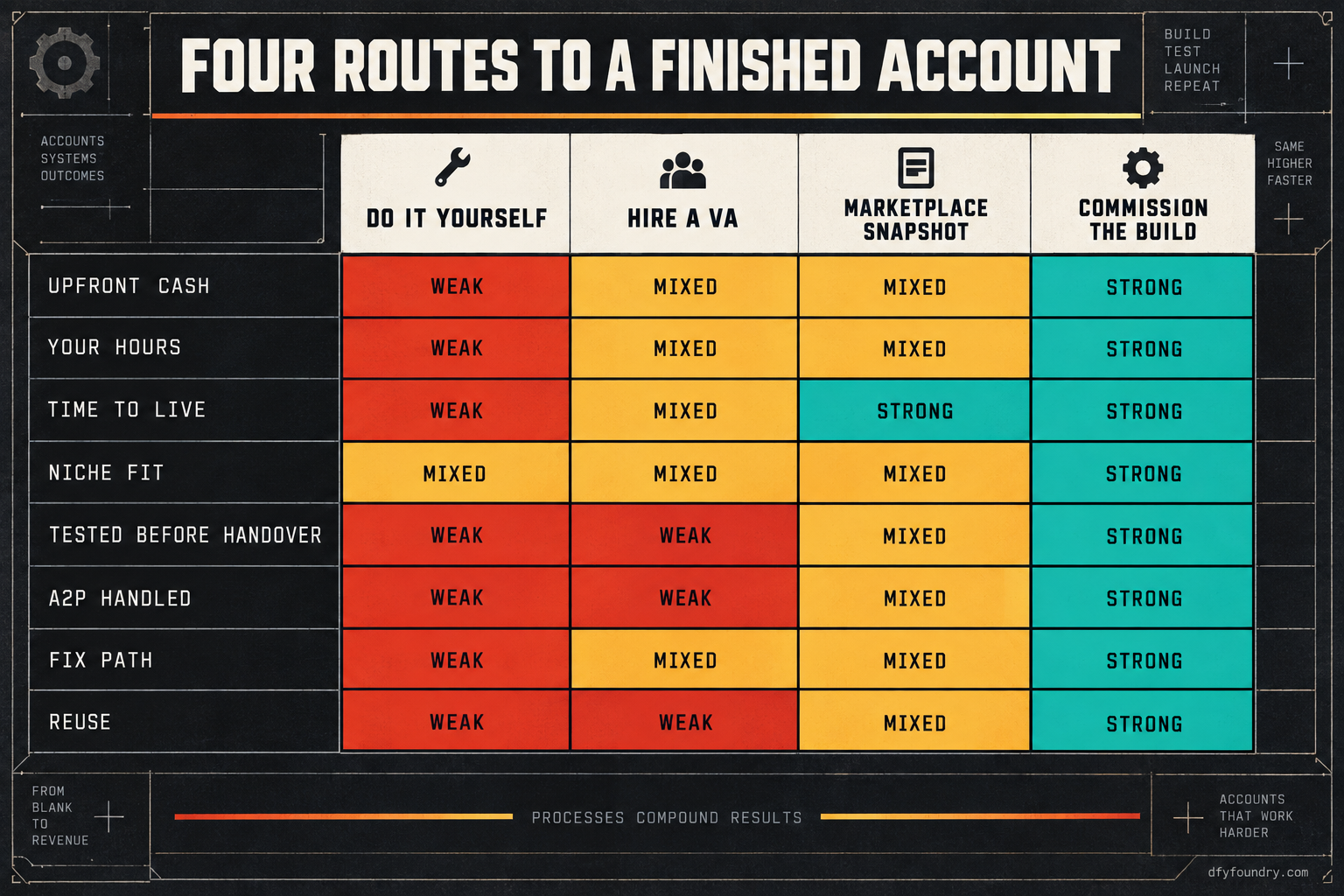
Eight criteria, side by side
Judge the four routes on what actually decides a hand-over, not on sticker price alone. These are the eight that predict whether the account is still running in month three.
| Criterion | Build in-house | Hire a VA | Marketplace snapshot | Commission the build |
|---|---|---|---|---|
| Upfront cash | Near zero | Low to medium | Lowest | Highest |
| Your hours | Highest | Low, plus review | Medium, all repair | Near zero |
| Time to live | A weekend or more | Days | Minutes to import, then repair | Within 24 business hours |
| Niche fit of copy and cadence | As good as you write it | As good as the VA knows the trade | Varies wildly | Written per niche |
| Tested end to end before handover | If you test it | If you check their work | Almost never | Yes, before the client logs in |
| A2P and 10DLC handled | You file it | You must direct it | Not included | Inside the support hours |
| Fix path when it breaks | You already know it | Depends on the VA | You, alone, guessing | Support window, then quoted work |
| Reuse across future clients | High, once built | Medium | Medium | High, per niche |
Read down the columns, not across the rows. Build in-house wins on control and reuse and loses your weekend. A VA wins on cost per hour and only if the trade knowledge is already there. A marketplace snapshot wins on cash and speed to import, and loses on everything that happens after the import. Commissioning wins on your time and on finish, and costs the most in cash.
Now match a column to a reader. If you sell into one niche over and over and you have a build you already trust, build in-house or clone your own, and never pay anyone. If you have a proven VA who knows the trade, hand it to them and review the work. If the account is a favor, an internal test, or a client on the smallest possible budget, a marketplace snapshot is the honest answer. If the account is billable, the client is watching the calendar, and your own hours are the scarce thing, commission it. The snapshot installation service exists for the middle case, where you have a file you like and want someone else to wire it correctly.
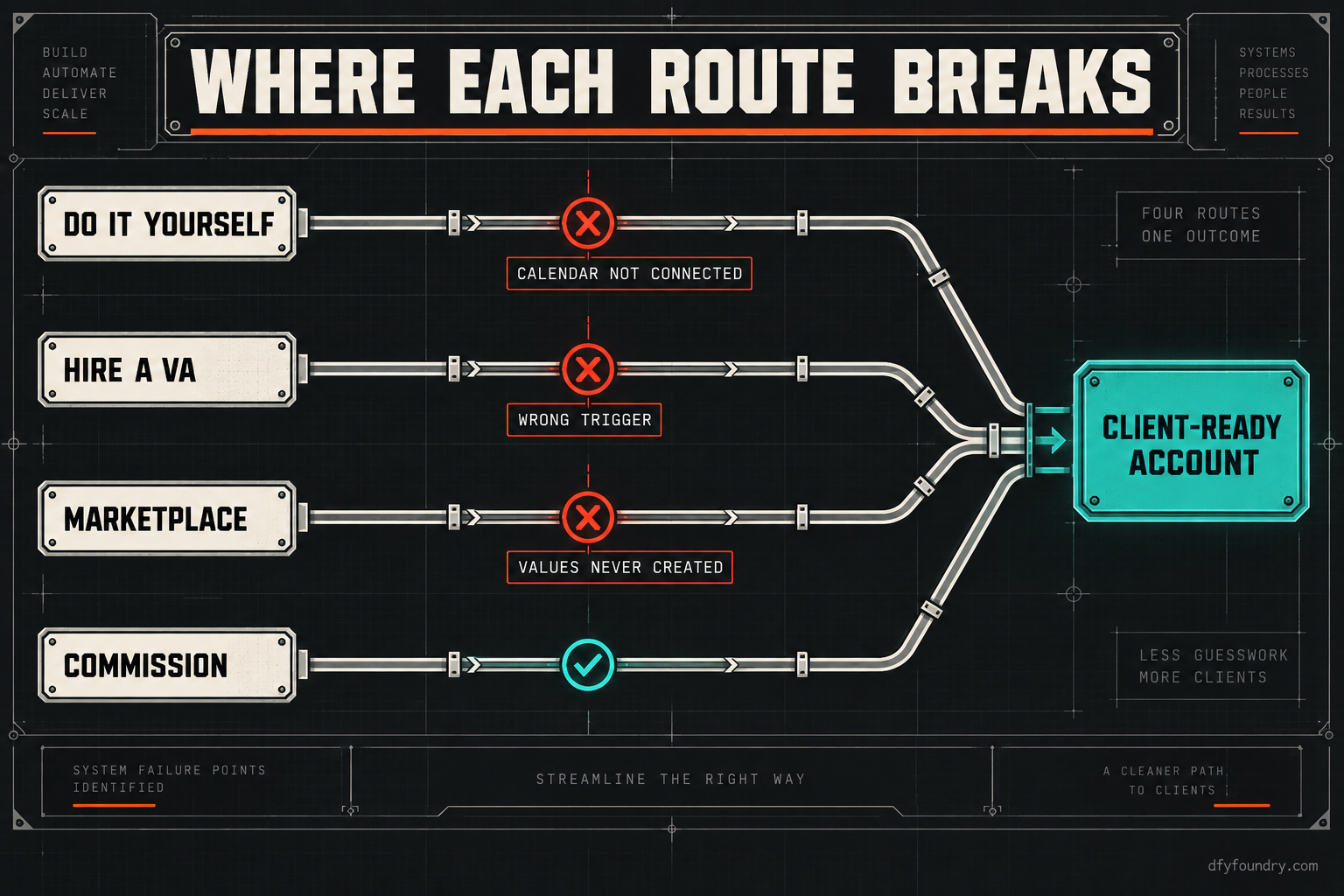
Where each route breaks
Every route has a failure mode that shows up after the money is spent. Knowing them in advance is most of the decision.
The in-house build that eats the weekend and ships half-wired
The build itself goes fine. You know GoHighLevel. What gets you is the last ten percent, the connections that are not in any file. You test the funnels, you test the workflows in the builder, everything looks green, and you hand it over. Then the client books an appointment and it never reaches them, because the calendar is still on your Google account, not theirs. Or the first SMS blast returns nothing, because the A2P campaign is still pending. In-house builds rarely fail on logic. They fail on the boring connection work at 11pm on a Sunday, when you have stopped checking carefully because you are tired and it is your own weekend you are spending.
The VA who is really learning on your account
A VA build breaks in a specific, recognizable way: it is technically complete and behaviorally wrong. The workflow exists, but it triggers on the form submission instead of the appointment booking, so the reminder fires the second someone fills out the form and never again. The pipeline stages are there, but they are the generic sales stages, not how a roofer moves a storm-damage claim. Nothing is missing. Everything is slightly off, in the way that only someone who has never run that trade would get wrong. You find out when the client, who does run that trade, asks why the automation makes no sense. If you use a VA, hand them a build to install and adapt, not an empty account to invent, and check the triggers yourself before anyone logs in.
The marketplace snapshot with workflows pointing at values that do not exist
This is the classic, the one in the opening scene. A cheap or hastily built snapshot imports perfectly and does nothing. The most common cause is workflows referencing custom values that the snapshot’s author had in their own account but that never got packaged, so the reference imports as a blank and the step silently does nothing. The second is workflows left in draft rather than published, so they exist and never run. The third is triggers pointing at a form or calendar that was recreated on import with a new ID, so the wiring is broken at the join. You cannot see any of this from the sales page. You see it four hours into the install, which is exactly when the time you thought you were saving turns into the time you are spending twice.
The commissioned build that is really a marketplace snapshot with an invoice
Commissioning is not immune, and this is the failure mode to watch for when you hire anyone, us included. A seller takes a generic snapshot, changes the business name, and calls it a custom build at a custom price. The tell is the copy. Open the email and SMS content and read it. If the follow-up cadence reads like every other trade with one noun swapped, it is not a build for your niche, it is a template with your logo on it. Ask to see a page of the actual email copy before you buy. A seller who will not show you one email is telling you what is inside. The whole reason to commission rather than buy off the shelf is that the writing and the cadence are done for the trade, and if they are not, you are paying build prices for marketplace work.
The route nobody costed: A2P registration, on every route
One failure mode sits across all four. US SMS does not send until the sub-account has a registered 10DLC brand and campaign, and that registration is per account, takes real days to clear, and is nobody’s default. Build in-house and you have to remember to file it. Use a VA and you have to make sure they did. Buy a marketplace snapshot and it is explicitly not included. Commission a build and confirm it is inside the scope, because on our floor A2P and 10DLC registration is one of the things the fifteen installation hours cover. Whichever route you pick, treat the phone side as unfinished until you have watched a real message send and arrive. The account can look complete and be mute.
The numbers, with the assumptions on the table
Cash is the easy number. Your hours are the one that decides it, so price them. Assume, for the arithmetic below, that an hour of your time is worth $75, and that a first-time niche build, wiring and testing included, runs twenty to forty hours. Substitute your own hourly figure and your own build speed and the ranking can change. That is the point of showing the work.
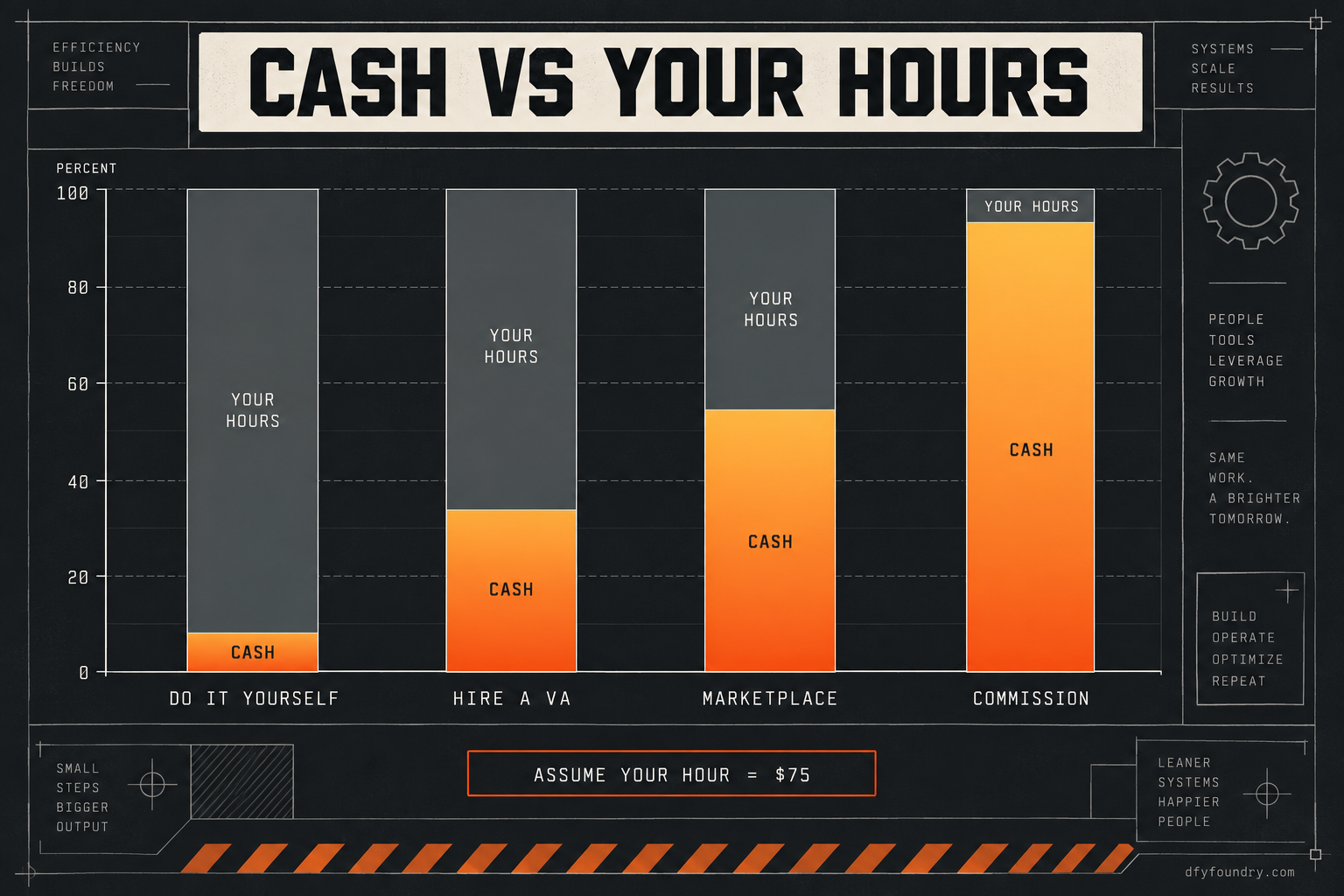
Build in-house. Cash out of pocket is near zero, because you already pay the GoHighLevel subscription. Priced at $75 an hour, twenty to forty hours of your time is $1,500 to $3,000 of value, spent on a weekend you do not get back. If your hours are genuinely idle and your time is not billable, that value is lower. If you could have closed a deal instead, it is higher.
Hire a VA. Offshore GoHighLevel VAs bill roughly $8.50 to $16 an hour once vetted, per published 2026 VA rates, and dedicated monthly VAs run about $449 to $1,500 a month depending on the provider, per GoHighLevel VA cost guides. A competent VA taking twenty-five to thirty-five hours on a first niche build at $12 an hour is roughly $300 to $420 in cash. Add your own review time, call it four to eight hours, or $300 to $600 of your value, and more if you have to send it back.
Marketplace snapshot. Pre-made niche snapshots sell for about $97 to $497, with premium packs reaching $997, per marketplace snapshot guides and vendor listings. Then add the repair: four to eight hours the first time you install a given build, or $300 to $600 of your time at $75, and that assumes the snapshot was wired well enough to only need repair rather than a rebuild.
Commission the build. Our own catalog runs $920 to $2,280 per snapshot, each one a done-for-you build installed and tested before hand-over, with installation free and fifteen hours of support inside the first eight days. Your hours on this route are close to zero, which is the whole line item you are buying. For comparison, the subscription underneath all four routes is HighLevel’s, not ours: Starter $97 a month, Unlimited $297, Agency Pro $497, on prices HighLevel published in 2026, with a 14-day trial on every plan.
So the ranking flips depending on one input. If your time is worth nothing this weekend, build it yourself. If your time is worth $75 an hour and billable, a commissioned build at, say, $1,380 for a roofing company snapshot or $1,440 for an HVAC company snapshot is cheaper than the twenty to forty hours you would otherwise burn, and it arrives tested. The marketplace snapshot only wins outright when the budget is hard-capped below our floor and you accept the repair time as the cost of that cap.
Objections, in their strongest form
“A marketplace snapshot is a fraction of the price. Why would I pay build prices?” Because the price you compare is not the price you pay. A $297 snapshot plus six hours of repair at $75 is $747 and a working account, if it was built well. A $297 snapshot plus a rebuild is $297 and a wasted afternoon. The commissioned price includes the hours the marketplace price hides, plus the A2P filing, plus the account being tested before your client sees it. If your repair time is reliably short because you install snapshots all week, the marketplace route genuinely wins, and you should take it.
“My VA can just build it, that is what I pay them for.” If your VA has built that niche repeatedly, agreed, and you should not pay us. The objection only holds when the trade knowledge is already in the room. The moment your VA is meeting a niche for the first time on a live client account, you have swapped a cash cost for a risk cost, and the risk is a hand-over that is subtly wrong in ways the client notices before you do. Use the VA for the niches they know cold, and buy the ones they do not.
“Why commission from you specifically, rather than the cheapest done-for-you build I can find?” Sometimes you should not. If price is your only constraint, we are not the cheapest and we will not pretend to be, because our builds sit above an $850 floor and the market has snapshots well under that. What you are paying the difference for is niche copy written per trade rather than a template with a swapped noun, an account tested end to end before hand-over, and the installation and account setup done inside a stated support window rather than left to you. If you do not value those three things, buy cheaper. If you have been burned by a build that imported clean and shipped mute, you already know what they are worth.
“I have done this before and it was fine.” Then you have priced your own hours and decided they are available. That is a legitimate answer, and it is route one. This piece is not an argument that commissioning always wins. It is an argument that the four routes cost different things, that the biggest cost is usually your time rather than your cash, and that “finished” means tested and connected, not imported. Pick the route that matches the account in front of you, and cost your weekend before you spend it.
Questions on this
Cheaper in cash, not in cost. You already pay the subscription, so the out-of-pocket is near zero. The real bill is your hours. A first niche build runs twenty to forty hours, and those are hours you did not spend selling. Cheap only holds if your time is worth nothing.
Yes, if the VA has built that exact niche before. The risk is a VA learning the trade on a live client account, where a workflow wired to the wrong trigger sends at four in the morning. Hand a VA a build to install, not a blank sub-account to invent.
Price and finish. A marketplace snapshot is a file you import and then repair yourself, often with workflows pointing at custom values that were never created. A commissioned build is installed, rebranded, registered for A2P and tested end to end before your client logs in.
We ship within twenty-four business hours of purchase confirmation. Business hours are nine to five Central, Monday to Friday, so an order placed Friday afternoon lands Monday. Installation is free, and you get fifteen hours of dedicated installation support to spend within eight days.
Yes. Every route installs into a GoHighLevel account you already run. The subscription is HighLevel's, billed by HighLevel, and has nothing to do with what a build costs. Starter runs $97 a month, Unlimited $297, Agency Pro $497, on prices published in 2026.