ST-05 · TEMPER
How Many GoHighLevel Accounts Can You Manage
Selling GoHighLevel builds is the easy part. Keeping them healthy is the ceiling. How to find your real account limit, and whether to cap intake, hire, or buy the builds.
It is six on a Friday and you open the board to shut it down for the week. The eleventh account you onboarded this year is sitting there with a client email from Tuesday you never answered. She says the booking calendar shows no availability, ever, for anyone. You open it. A workflow that ran clean at hand-over now points at a Google calendar the client disconnected three weeks ago when she moved her practice to a new email. It has been dead nine days. While you are in there you notice the account two rows up has an A2P campaign flagged, and the one below it stopped sending review requests in August because the client changed their business number and nobody repointed it.
You built all eleven of these accounts properly. That is not the problem, and it is worth being clear about, because the instinct is to blame the builds. The builds were fine. The problem is that eleven live accounts each quietly want an hour of your attention a month just to stay upright, and there is one person on this floor to give it to them, and that person also has to sell the twelfth. The account you can build is not the constraint. The account you have to keep running is. This is the number every agency gets wrong, because the platform hands you a seat count that has nothing to do with it.
The build is the cheap part
Here is the thing the seat count hides. Fulfilment is not building accounts. Building is the loud, visible, front-loaded part that feels like the work, and it ends. Fulfilment is keeping accounts healthy after the build ships, and that does not end until the client leaves. When you price an agency at so-many-accounts, you are almost always pricing the build and ignoring the tail, and the tail is where capacity actually dies.
Walk one account through its life. It comes in as intake, gets built, gets handed over, and then it runs. That last word is doing a lot of hiding. A live GoHighLevel sub-account is not a finished object sitting on a shelf. It is a machine wired to things that move underneath it. The client changes their Google account and the calendar link breaks. Their offer changes for the season and the funnel copy goes stale. A number gets ported and the SMS stops. The sending domain’s reputation drifts and email starts landing in spam. A workflow that was perfect in March fires on a trigger that no longer matches how the client takes leads in September. None of that turns anything red. It just decays, one small disconnection at a time, on every account you are not looking at.
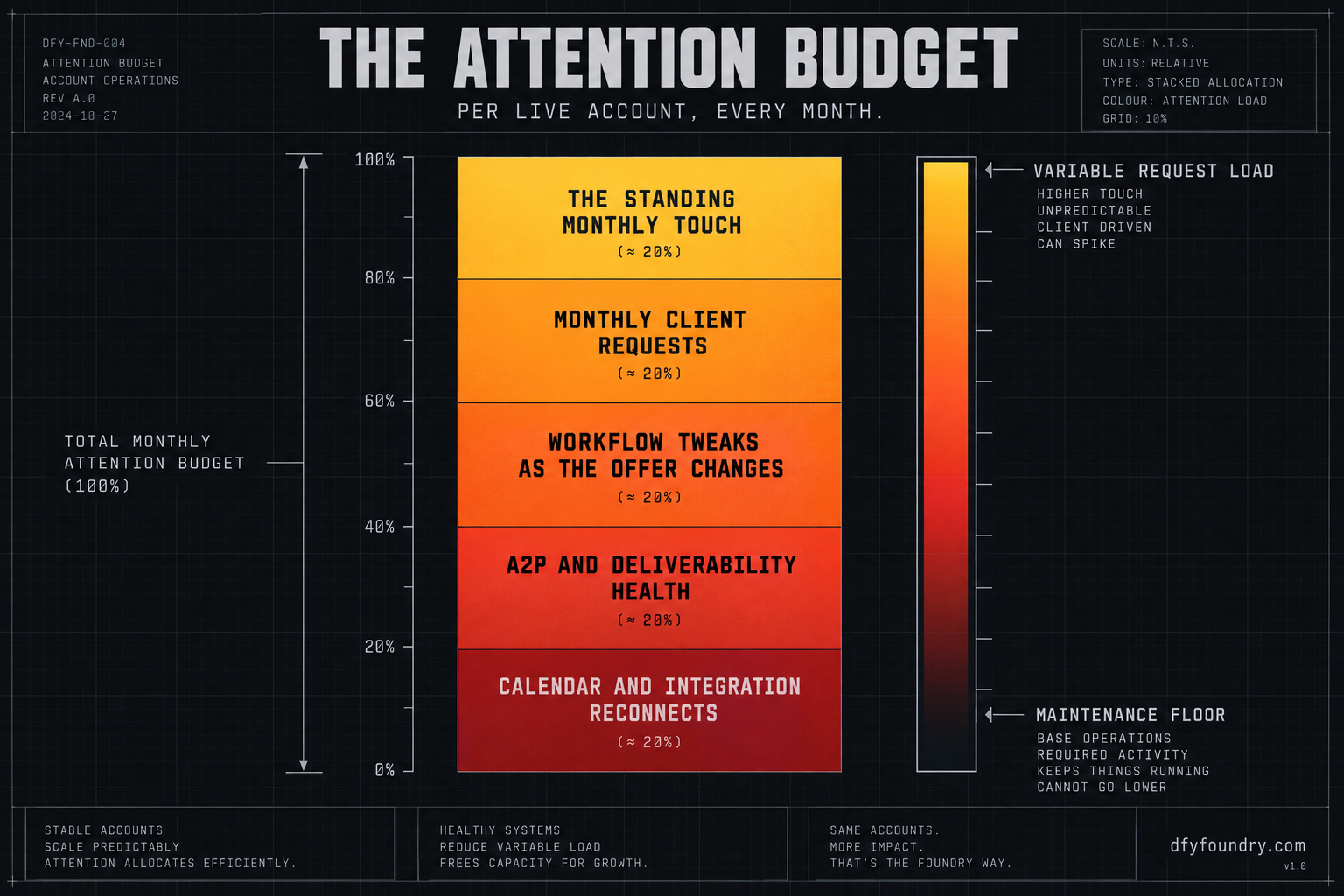
On top of the decay there is the request load. The client wants a form added to the new landing page, a stage renamed in the pipeline, a reminder moved an hour earlier, a report on last month. Small, reasonable, and constant. And then there is the work you should do whether or not anyone asks: the monthly touch that catches the dead calendar before the client does, and the quarterly pass that hunts dead workflows, broken links and drift from your template.
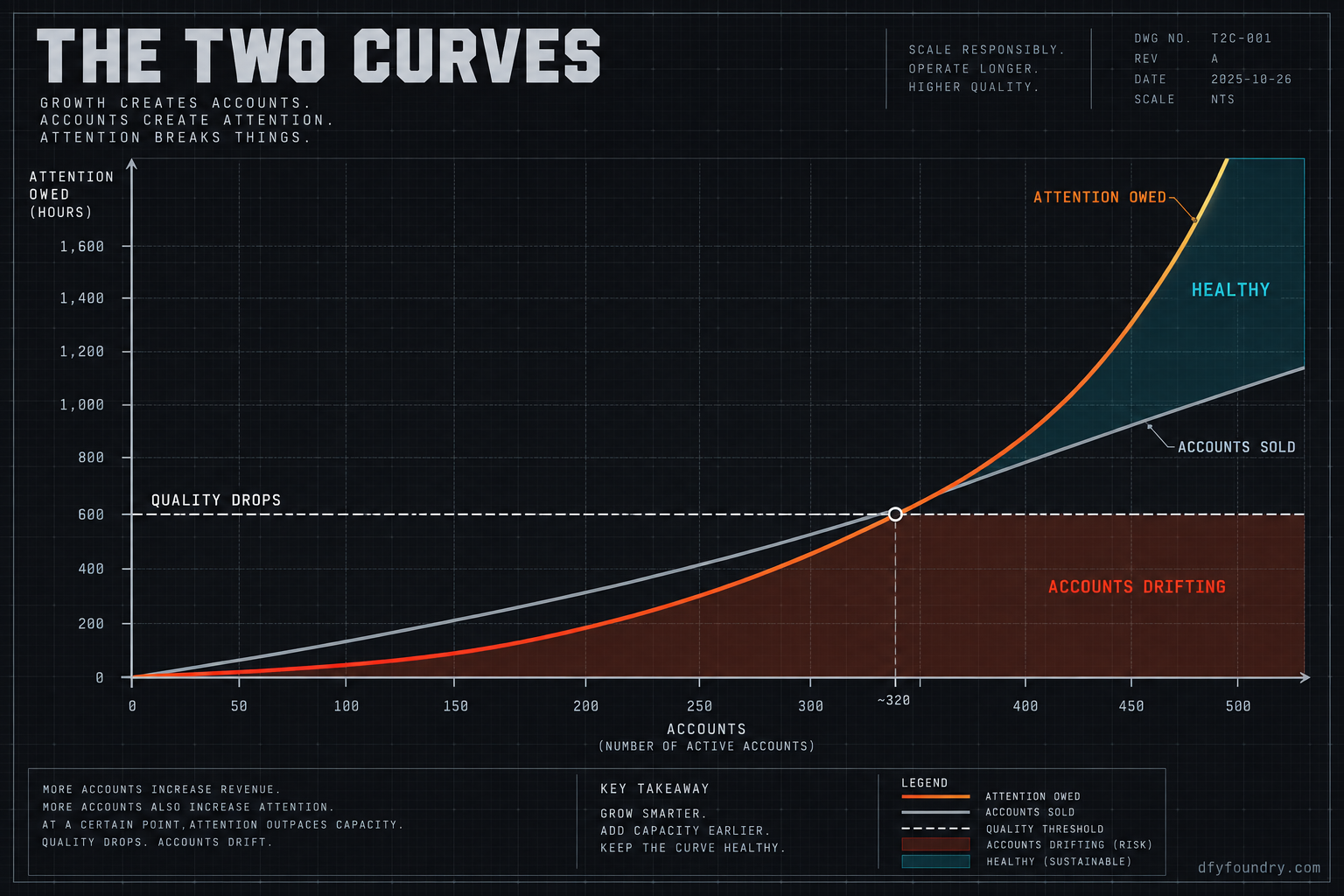
Add those up and each live account carries an attention budget. Call it a floor of maintenance hours per month just to not decay, plus a variable load of requests on top. That budget is the real unit of capacity, and it is why the seat count lies to you. Your revenue grows with accounts sold. Your maintenance load grows with accounts running. Those two lines start together and then they separate, and for a while the gap feels like profit, because the debt is invisible and compounding on the accounts you onboarded first. You feel rich right up to the Friday you open the board.
There is one multiplier that decides whether this budget is survivable, and it is the single most important lever you own: uniformity of build. If every account you run is a bespoke one-off, then every maintenance touch starts with you re-learning how that particular account was wired, because nothing you fixed last week applies here. If your accounts are clones of a single template with a shared naming convention, a fix you learn once applies everywhere, and a VA can be trusted with the repeatable part because the repeatable part actually repeats. Agencies that scale fulfilment do not do it with heroics. They do it by making their accounts similar enough that attention spent on one buys knowledge that pays out on the rest.
Where the ceiling actually breaks
The ceiling does not announce itself. It shows up as a handful of symptoms that look like separate problems and are all the same problem wearing different hats. Here are the ones that come off the floor most often, in the order they tend to bite.
The account nobody has touched since month one
What you see. A client churns at around ninety days with some version of “it just isn’t doing anything.” They are not angry. They are bored, and they are right.
What is wrong. The account decayed and no one was watching. The calendar went dead, the A2P campaign got flagged, the seasonal offer never got swapped, and because none of it errored, nothing pulled your eye back to it. You were building the new accounts. This one aged out in silence.
The fix. Put a standing monthly touch on every live account, on a schedule and not on a complaint. Thirty minutes to confirm the calendar books, a test lead sends clean, the campaign is healthy and the offer is current. The point of the cadence is that it runs before the client notices, because after the client notices you are not maintaining an account, you are saving one.
You are the single point of fulfilment
What you see. You cannot take a week off. Every account, every request, every fix routes through you, and the queue does not move when you step away from it.
What is wrong. Nothing is written down or handed off, so all the judgment and all the muscle memory live in one head. That is not a team. It is a bottleneck with good intentions, and it caps the agency at exactly one person’s worth of hours forever.
The fix. Separate the judgment from the labour. Write the runbook for the repeatable work, standardise the build so there is a runbook to write, and hand the clone-and-maintain work to someone under supervision. Keep only the calls that genuinely need you. The account setup service exists partly to build that template and hand it over as a document, because a blank sub-account you clone is what makes the rest delegable.
The VA scales volume but not judgment
What you see. You hired help, the ticket count started clearing fast, and then a reminder fired at four in the morning to an entire list, or a live workflow got edited mid-run on the wrong account.
What is wrong. You handed over the work without the guardrails. No least-privilege access, no supervised window, no written line between what the VA touches and what they must never touch. Speed without a boundary is just a faster way to reach a live client account and break it.
The fix. Name the accounts the VA can reach and grant nothing beyond them. Put a builder behind their work for the first two weeks so nothing untested lands on a client. Write down the never-touch list before the first job, not after the first incident. Volume is fine to delegate. Judgment gets earned, and it gets earned under review. That guardrail is the whole shape of the VA arrangement we run.
Intake is outrunning fulfilment
What you see. Sales is the best it has ever been. Quality is quietly the worst it has ever been, and the accounts you onboarded first are the ones getting neglected to make room for the new ones.
What is wrong. You are selling capacity you do not have. Every account you add steals maintenance attention from the accounts already running, so growth on the sales side reads as decay on the fulfilment side. The faster you sell, the faster the tail rots.
The fix. Cap intake to your real attention budget, or add fulfilment capacity before you sell it, not the month after. The order matters. Adding hands after you have oversold means the new capacity spends its first weeks putting out fires instead of taking on the next client cleanly.
Every account is a one-off
What you see. No two accounts share a workflow, a naming convention or a structure, so no fix you make ever applies more than once, and every touch feels like the first time you have seen the account.
What is wrong. You optimised each build for its client and, in doing it, threw away your own compounding return. Bespoke everywhere means your attention budget per account never falls, no matter how many accounts you have run, because experience does not transfer between them.
The fix. Standardise on a template and a naming convention, and customise at the edges rather than the core. The client still gets an account tuned to their trade. You still get to carry one mental model instead of forty. This is the difference between a shop that gets slower as it grows and one that gets faster.
The client is in there editing too
What you see. An account you know you built correctly starts misbehaving, and nothing on your side changed. A calendar has vanished, a workflow step is gone, a pipeline stage got renamed to something the copy no longer matches.
What is wrong. The client has a login and has been in there, moving things, deleting what looked like clutter, wiring up an integration they read about. Every self-serve client raises the attention budget in a way you cannot schedule, because now your monthly touch is also a forensic one, working out what got changed before you can work out what to fix. The account is not decaying on its own. It is being edited out from under you.
The fix. Decide per client whether they get edit access at all, and scope it tightly when they do, the same least-privilege thinking you apply to a VA. Where a client insists on their own hands in the build, price that account higher, because an account someone else edits costs more to keep upright and you should charge for the difference rather than absorb it into a budget that was already tight.
The arithmetic of your own ceiling
You can put a number on this, and you should do it with your own inputs rather than mine, because the whole point is that your ceiling is yours. Everything below is a labelled assumption you can replace.
Start with the meter that does not move. A GoHighLevel Unlimited plan runs $297 a month, and Agency Pro runs $497 a month, on prices published in 2026 (GoHighLevel). Both allow unlimited sub-accounts, so the platform is not your constraint and never will be. That charge is flat whether an account is thriving or drifting, which is the first thing to internalise: a neglected account costs you the same subscription as a healthy one and earns you a churn instead of a renewal.
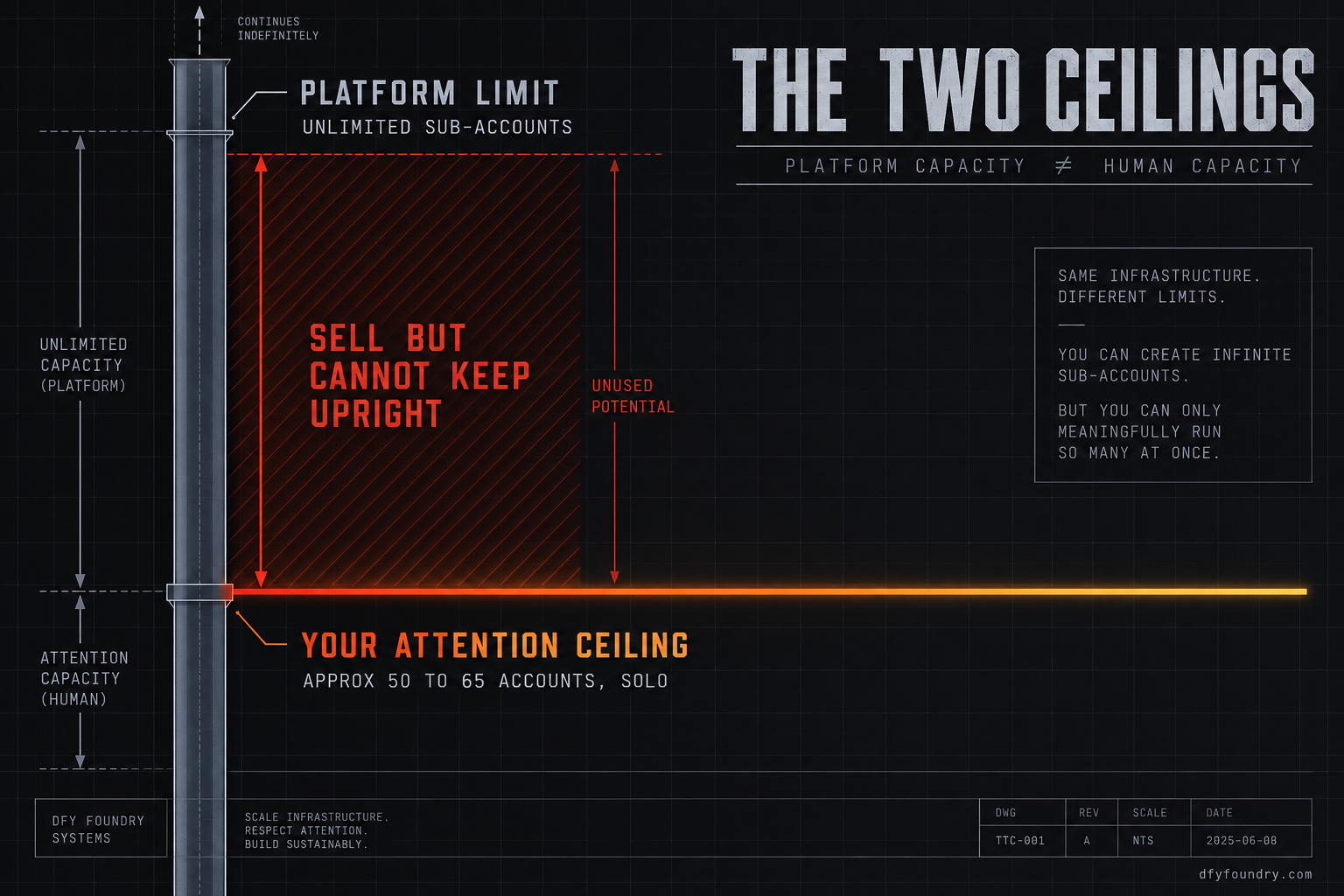
Now the real limit. Say a live account needs a maintenance floor of one hour a month just to stay upright, before any client requests. That is an input, so set your own. Say one full-time person has, realistically, around twenty-five hours a week to spend on maintenance rather than selling or building, which is roughly a hundred hours a month. On paper that is a hundred accounts. It is not a hundred accounts. Context-switching, the request load on top of the floor, and the re-learning tax on bespoke builds all eat into it, so the effective budget per account is more like ninety minutes to two hours once you are honest. That lands the real solo ceiling somewhere between fifty and sixty-five accounts, and lower if your builds are all one-offs. Run those three numbers with your figures, your hours and your build discipline, and you have your own ceiling. It will be well under the platform’s infinity.
When you hit it, there are three honest moves, and here is what each one costs and buys.
| Move | What it costs | What it buys |
|---|---|---|
| Cap intake | Growth you turn away | Every running account stays healthy; free to do today |
| Add hands (a VA) | From $1,400 a month | Repeatable maintenance and builds cleared under your supervision |
| Add a bench (fulfilment) | From $2,400 a month | Capacity plus a running queue, monthly report and quarterly audit |
There is a fourth lever that is easy to miss: move the build load off your bench entirely. A commissioned build arrives installed and tested, so the hours you would have spent assembling it go to keeping accounts healthy instead, and build hours are the easiest hours to hand off because they are the most repeatable. Our own builds run from $920 for the car wash snapshot up to the higher end of the catalogue, and the pricing page has the band. If you would rather price the trade in founder-hours, take the VA line: $1,400 a month against, say, twenty founder-hours it frees is about seventy dollars an hour of your own time reclaimed. Swap in your rate and decide whether that trade clears. None of these are measured results. They are a method, so you can run it on your own book.
The objections, answered straight
“Unlimited means unlimited sub-accounts, so there is no ceiling.” The platform ceiling is real and it is enormous and it is not your ceiling. GoHighLevel will happily let you run three hundred sub-accounts on one Agency Pro plan (GoHighLevel). Your ceiling is attention, and attention is a much lower and much harder number, because it is measured in hours you actually have rather than seats a subscription allows. Confusing the two is the single most expensive mistake in this business, because it lets you sell right past the point where you can keep the promise.
“My accounts run themselves once they are built.” Some do, for a while, and the ones that do are the standardised builds with a maintenance cadence behind them. The bespoke account you have not opened since June is not running itself. It is drifting, and it is drifting silently, and the first signal you will get is a churn notice. “Runs itself” is a property you engineer with uniformity and a monthly touch, not a default state a build ships in.
“Why pay you for fulfilment when I can hire my own VA and systematise it myself?” You can, and if your build is standardised and your runbook is written, that is exactly the right move, and the VA arrangement is that path with the guardrails already fitted. What a fulfilment bench buys is the queue, the cadence and the quarterly audit already running on day one, for a shop that would rather spend its week selling than managing a board. If you would rather own the system yourself, own it, and the white-label setup work templates the delivery so you can. The honest answer is that the right lever depends on whether your constraint is hands, systems or time, and we would rather you pull the correct one than the one with our name on it. Buying support you do not need is its own kind of leak, and the true cost of a support subscription is worth reading before you sign one.
Find the ceiling before it finds you
The account you can build was never the question. Building is the front-loaded, visible, finite part, and almost everyone can add one more of it. The account you have to keep healthy is the real unit, it compounds with every client you take on, and it decays in silence on the ones you stop watching. That is why the platform’s seat count is the wrong gauge and your attention budget is the right one.
So run the arithmetic on your own book this week. Set your maintenance floor per account, set your honest maintenance hours, cut it for the re-learning tax your bespoke builds charge you, and you will have a real number instead of the platform’s infinity. Then pull a lever on purpose: cap intake, add hands, add a bench, or move the build load off your floor so your hours go where the value leaks. If you would rather the running of it were somebody else’s queue, that is what ongoing fulfilment is, and a build like the HVAC company snapshot or the dental clinic snapshot arrives already off your bench. Either way the rule holds. Never sell the account you cannot keep upright, and know your ceiling before a Friday email tells you where it was.
Questions on this
The platform does not cap it, so the real limit is attention, not seats. Work from the maintenance hours a live account needs each month, divide your available fulfilment hours by that number, and cut the result for context-switching. For a solo operator managing bespoke builds, the honest ceiling is far lower than the platform suggests, and it drops the moment you sell faster than you can tend.
No. The Unlimited plan allows unlimited sub-accounts, which is exactly why the platform seat count is a poor gauge of capacity. GoHighLevel will let you spin up hundreds of accounts on one plan. Whether you can keep hundreds of accounts healthy is a question about your fulfilment hours, not your subscription.
A VA adds hands for repeatable work under your supervision and suits a shop with a written runbook and a standard build. A fulfilment bench adds capacity plus a cadence and a queue that already runs, and suits a shop that would rather sell than manage the work. If neither is in place yet, capping intake to your real attention budget is the free option while you build the system.
Because a build ships healthy and then drifts. A client reconnects a Google account and the calendar goes dead, an offer changes and the copy goes stale, a number changes and the review sequence stops. None of it errors. Without a standing monthly touch on every live account, the drift is invisible until the client says the account is not doing anything.
It moves the build hours off your bench so your own time goes to keeping accounts healthy rather than assembling them. A commissioned build arrives installed and tested, with free installation and 15 hours of dedicated installation support to be used within 8 days of purchase. That is build load you no longer carry, which is the load easiest to hand off.